Large language models at the upstream organizations.
LLMs like ChatGPT and others are showing great promise in fielding sophisticated industry-targeted questions, especially if they have be trained on industry-focused document repositories. SPE, EAGE and SEG have been working on this for a while with some success. What remains to be seen is how the technology will be marketed. Will it be free to the membership?
This article is approximately 911
words long. Click here
if you would like to request a complimentary copy.
The polo of kings
Former SLB seismic expert tells a ‘story’ of seismic data formats, proprietary and open source as a decades-long game played between the major operators and software vendors. All the while ignoring standards, both inside and outside the industry.
This article is approximately 1197
words long. Click here
if you would like to request a complimentary copy.
EarthDocAI, a very personal test drive
Oil IT Journal editor Neil McNaughton takes the EAGE EarthDoc.AI out for a spin. The results are impressive. But EarthDoc.AI’s understanding of Paris basin geology misses some critical information that clarifies the early history of the Villeperdue discovery. Old scores are settled!
In this edition’s lead we report on the orgs’ (EAGE, SPE and SEG)
efforts to use large language models to expose their various document
repositories and enable something more than just ‘search’. Something
‘intelligent’. It is after all,‘AI’. I thought I would give the most advanced of these initiatives ( EarthDoc.AI from the EAGE) a whirl.
In an earlier life I was involved in Paris basin exploration (yes,
in the 1980s that was a thing) and the company I was working for,
Triton France, was ‘re-exploring’ a small oil discovery that had been
abandoned by its previous owner. So I asked EarthDoc.AI not exactly a
trick question, but one which I knew quite a lot about. It is in
general interesting to ask questions to which you know the answer just
to see if the person (or now the machine) is a BS artist*. I asked:
What is the trapping mechanism of the Paris Basin Dogger oilfields?
To which EarthDoc.AI replied:
The Dogger oil fields in the Paris Basin exhibit various
trapping mechanisms. A significant proportion of these traps,
approximately 30% of total reserves, have stratigraphic components. The
Paris Basin contains two primary oil reservoirs: the Dogger oolitic
limestone and the Keuper sandstone. The main source rock for oil in the
basin is the Toarcian shales. These organic intervals are situated
between the Dogger carbonates and Triassic clastics, forming an
efficient petroleum system.
Trapping mechanisms for hydrocarbons can include structural and
stratigraphic styles. Structural traps can involve anticlines, where
hydrocarbons accumulate at the crest of a dome, sealed by an
impermeable layer. Stratigraphic traps often rely on lateral changes in
rock properties, such as updip pinchouts or permeability barriers.
Specific examples of trapping in the Paris Basin Dogger include
the Villeperdue field, which is characterized by an unexpected
stratigraphic trap containing 53 million barrels of oil. Initial
interpretations involved a transverse-faulted four-way closure, but
further appraisal revealed a westward plunging nose and an updip
permeability barrier, with trapping enhanced by artesian hydrodynamic
flow.
EarthDoc continued with lots more interesting stuff along with the
eight papers that it identified as key to its reasoning. I must say I
was impressed by EarthDoc.AI’s explanation of Dogger trapping
mechanisms and particularly pleased that it used Villeperdue as an
example. When I worked for Triton I was not really the person that
‘found’ Villeperdue (it had already been found!). I did though have the
honor of naming this quite substantial oilfield. I was the geophysicist
that produced the map that encouraged Triton (on what was then a
farm-in for Total) to drill the VPU1 discovery.
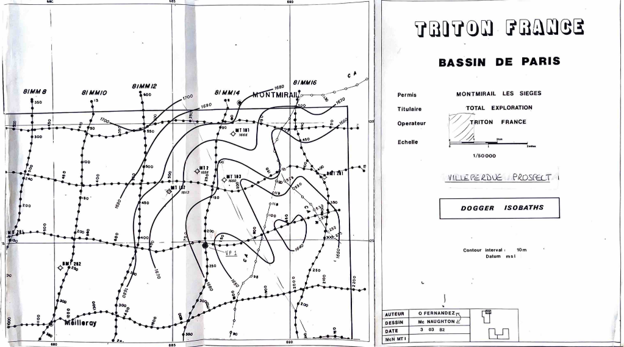
But what EarthDoc does not know is that the ‘initial interpretation’
story of the literature is complete baloney! In reality, the seismics
showed a monocline (see the map below showing my very own work!).
Unfortunately, management, for some reason, was not happy with a
monocline and wanted ‘three way closure’ which was duly provided by the
geologist who went on to present the story at the AAPG from where in
entered the literature. I always thought it curious that the idea of a
stratigraphic trap seemed foreign to our management since they hailed
from the home of the East Texas field, a stratigraphic trap which was a
bit more substantial that Villeperdue!
Is there a moral to this conversation with AI? Maybe there is. A
more authoritative AI might have noticed that a ‘transverse-faulted
four-way closure’ in the Dogger of the Paris basin is rather
improbable. This particular Gen AI exchange is good, but remains a
supercharged literature search. It is not adding real geological
‘intelligence’.
* On which topic see my 2023 interrogation of ‘ChatGPT: a world-class bullshit artist’.
Diving into the subsurface
Another team of Norwegian researchers has been investigating OSDU, the Open Subsurface Data Universe, in a case study of subsurface data ‘contextualization’. Their MSc Thesis investigates how Equinor is ‘transforming’ its subsurface workflows. Main finding? The transition ‘reorganizes rather than replaces’ data workflows. The researchers identify some ‘gotchas’ in the OSDU approach. There is no free lunch!
This article is approximately 1254
words long. Click here
if you would like to request a complimentary copy.
HPC and AI Society Annual Event
Intersect360 ‘users want on-prem’ not cloud ‘ransomware’. Python now dominant language for HPC. Market moving slowly to low-precision, vibe-coded, and risk-tolerant. Can anyone challenge Nvidia? Trump’s AI Action plan heralds a ‘golden age of human flourishing, economic competitiveness and national security’. Nvidia presents Nemotron Parse work with SLB.
This article is approximately 768
words long. Click here
if you would like to request a complimentary copy.
AI in oil, gas and elsewhere…
Oil IT Journal reports on some AI trials and deployments in oil and gas and elsewhere. Chevron’s ApEX GenAI platform is ‘transformational’. Riverbed reports low take-up for AI projects. Capgemini sees declining trust in Agents. Equinor reports modest savings with AI deployment. BP leverages Palantir, Databricks in AWTO well designer. Mendo warns ‘shadow AI the new shadow IT’. US NIST struggles with AI standardization: proposes ‘zero draft’ quasi-standard.
This article is approximately 850
words long. Click here
if you would like to request a complimentary copy.
OSDU Article Feedback
Our Strategic Deadlock review of seminal OSDU thesis received some good feedback: ‘really resonates’, ‘will annoy AWS!’,‘you are saying the quiet parts out loud’,‘cuts through layers of hype’,‘OSDU an ill-defined shape-shifting monster’.
This article is approximately 393
words long. Click here
if you would like to request a complimentary copy.
Software, hardware short takes …
Detechtion rolls-out EZTasks.ai. EasyCopy’s EasyCore 3.2. Exprodat’s Exploration Analyst 3.2 and GIS benchmark. New Surfer from Golden. HighByte adds agentic AI to Intelligence Hub. PPDM announces ‘Thoth’. MathWorks releases Matlab Agentic Toolkit. Petrosys Exchange. Crystal’s Ruby vibration sensor. SLB AlphaSight ‘breakthrough’. New apps for SymphonyAI IRIS. TotalEnergies’ Panda. TerraNavitas ODIS Explore. Viridien Evergreen Data Solution. Esri ArcGIS Enterprise 12.1.
This article is approximately 812
words long. Click here
if you would like to request a complimentary copy.
ExxonMobil’s Digital Reality Ecosystem
Industry standards to support ‘visual way of working’. But which standards? ARC web? Digital Twin Consortium? CFIHOS? Or all of the above.
This article is approximately 272
words long. Click here
if you would like to request a complimentary copy.
Open AI model for seismic interpretation
Researchers from Norsk Regnesentral, the Norwegian Computing Center (NCC), in collaboration with Aker BP and Equinor, have developed an open source foundation model for seismic interpretation. Masked autoencoder models trained on DISKOS data.
This article is approximately 205
words long. Click here
if you would like to request a complimentary copy.
OSDU update
OSDU V1.0 out (at last!) hot on the heels of M26 (Mercury) now available on the Google cloud. Microsoft rolls-out CIMPL. Halliburton and SLB ‘onboard’ OSDU, sans endorsements from the marketing department. S&P gives OSDU a shout-out at CERA week. Gongs agogo at the OSDU Forum.
This article is approximately 444
words long. Click here
if you would like to request a complimentary copy.
Done deals …
ABL acquires SynergenOG. Chevron Technology Ventures backs robot lift specialist Kewazo. Edison Partners leads CleanDesign round. Expro Group redomiciles, buys Enhanced Well Technologies. Flowco completes Valiant deal. Halliburton acquires Sekal. Novi Labs has acquired Turing Analytics. Octave bags VXG. SAP to buy Reltio. SLB has acquired S&P’s upstream software portfolio. Weatherford re-re-redomesticates to the US.
This article is approximately 561
words long. Click here
if you would like to request a complimentary copy.
Sales, partnerships, deployments …
Emerson/Aramco team. Chevron Technology Ventures backs Oxford Quantum. Cognite deploys Nvidia to AkerBP. Control Station and Dimension Software partner. DeepOcean deploys to Woodside. Emerson teams with SiMa.ai. Petronas joins EnerGeo Alliance. GeoComputing enters Canadian market. L&T Technology Services teams with Assai Software. SAP partners with ANYbotics. SLB/NVIDIA announce ‘AI Factory for Energy’. Vår Energi deploys SLB Delfi. Siemens, Alibaba partner. Dell builds TotalEnergies ‘Pangea 5’. TGS awards ‘hyperscale’ contract to Tape Ark. TorchGeo joins forces with IBM Research.
This article is approximately 712
words long. Click here
if you would like to request a complimentary copy.
PIDX 2026 Spring Conference
Promanthus on AI-based equipment data cleansing. Edicom on e-invoicing in the USA and international.
This article is approximately 728
words long. Click here
if you would like to request a complimentary copy.
Standards stuff …
D-WIS context data Version 1. WPH Digital achieved ISO/IEC 42001:2023 certification. Agentic AI Foundation announced.
This article is approximately 193
words long. Click here
if you would like to request a complimentary copy.