Modeling of giant fields and turbidites Roxar's Irap RMS 7.2
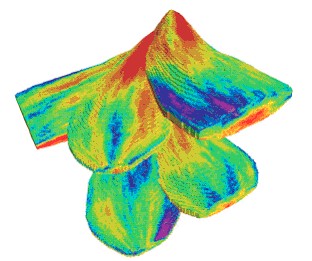
Modeling of giant fields and turbidites Roxar's Irap RMS 7.2
Halliburton unit Landmark Graphics Corp. has just announced two key national data bank wins—in Indonesia and Nigeria.
Indonesia
Landmark’s Jakarta-based unit, PT Landmark Concurrent Solusi Indonesia, has signed a ten year agreement with the Agency for Research and Development of the Indonesian Ministry of Energy and Mineral Resources. The deal covers the commissioning and ongoing operation of Indonesia’s National Data Centre (NDC).
2004
In the first phase Landmark will design and prepare for the establishment of the NDC in 2004. PetroBank technology will form the foundation of the data management solution and will be extended to include mining and minerals data as well as oil and gas.
Sembiring
Agency head Simon Sembiring said, “We believe a National Data Centre will help Indonesia attract more investors to develop the energy and mineral resources sector in this country.”
Nigeria
In a separate announcement, Landmark reveals that it has been awarded a five-year, $25 million contract from the Nigerian Department of Petroleum Resources. The contract, awarded to Landmark and its associate Integrated Data Services Limited (IDSL), calls for the design, development and operation of a National Data Repository (NDR) for Nigerian exploration and production data.
Communications
Landmark and IDSL will also be responsible for commissioning and delivering the communications infrastructures that will connect NDR subscribers to facilities in Lagos and Port Harcourt. Seismic, well and information assets in both digital and hard copy formats will be stored for secure access by entitled subscribers.
Ofurhie
Mac Ofurhie, Director, Department of Petroleum Resources, said, “From the inception of the oil and gas industry in Nigeria, storage and retrieval of exploration and production data accumulated over the years has proved a major problem. Nigeria chose Landmark’s PetroBank technology in recognition of its maturity and reliability”. PetroBank is also deployed at national data repositories in Brazil, Pakistan, Kazakhstan, Norway and the UK.
CGG’s manufacturing unit Sercel is ‘in final negotiations’ with Thales Underwater Systems (TUS) for the acquisition of the seismic equipment business of its Australian subsidiary. The acquired product line ranges from seabed to surface marine seismic equipment. Contrary to our report last month on Fugro’s acquisition of Thales GoeSolutions, the ARMSS seabed recorder belongs to the underwater systems unit and will be acquired by Sercel.
Hebei Junfeng
In a separate deal, Sercel has taken a controlling interest in Chinese seismic equipment manufacturer Hebei Junfeng Geophysical Co. Sercel acquired a 51% majority ownership in the company last month.
2 million phones
Hebei Junfeng was originally created by BGP, the largest Chinese geophysical services contractor. BGP will remain a shareholder alongside company management, employees and XPEIC, another Chinese equipment manufacturer. Hebei Junfen is the main provider of geophones and seismic cables for the Chinese seismic market. Junfeng employs around 500 people and manufactures nearly 2 million geophones per year.
Seems like we have been reporting a lot recently on the state of the industry. Of returns on investment and new business models. If you had too much of this stuff, my apologies in advance and a promise—that I have a more technical subject in the pipeline for next month’s editorial. But to get on with this month’s pontifications, I bring you first some snippets from the Society of Exploration Geophysicists convention held last month in Dallas.
Gaffney
Our latest crop of industry analyses, predictions and opinions was captured during The Leading Edge Forum—on the ‘Future of Petroleum’ no less. Our award for the ‘most heartfelt and least likely to have any effect’ talk goes to Peter Gaffney for his entreaty to ‘explore more—there are lots of under-explored basins still out there’. True perhaps—but too 1980’s to be taken seriously by today’s analysts, still fixated on the specter of $10 oil.
Rose
Peter Rose of Rose Associates accuses the industry of ‘habitual under-delivery’. In a study of 160 of BP’s evaluations, the company only realized around 45% of the originally estimated reserves. This translates into financial underperformance. In the period from 1989 to 1999 the industry returned a paltry 9% on capital as compared to 16% for the S&P 500*. Elsewhere a Wood Mackenzie study determined that the industry ‘only’ offers an 11% ROI. To do better, companies have to be more critical of there investments—which unfortunately for the geophysical industry is likely to be interpreted as an entreaty to ‘explore less’.
Farris
Apache president and CEO Steve Farris described how independents can ‘sweat’ assets better than majors. Examples of Apache’s acquisitions from Shell Oil in Australia, the US and Canada showed how the smaller company’s attention to detail has paid off. In one example, Apache has already made a return on investment over acquisition cost of 105% (since 1999) and there remain 70% of the reserves as estimated at the time of acquisition. Farris puts this down (charitably) to better seismics. But his real message is that these properties don’t really interest the majors—and that the independents are the ones who know how to ‘sweat’ an asset and to add value to old fields.
Wanna sweat?
The notion that smaller assets are better managed by smaller companies is fairly entrenched by now. Notwithstanding Apache’s success, the concept is seemingly at odds with the business world at large. To truly ‘sweat’ an asset, whether it is an auto plant or a supermarket, nothing beats being really big. It’s the GMs and Wal*Marts that are best placed to drive costs out of the system. Although whether they produce a humongous ROI depends on the state of the economy. Smaller companies operating in auto or retail usually tend to offer more than just sweat—something extra in the form of quality, perceived or otherwise, justifying a higher mark-up.
CERA
A new study** authored by David Hobbs of Cambridge Energy Research Associates (CERA) sheds more light on the economics of changing ownership. Hobbs asks what new operators in the North Sea do that their predecessors didn’t—and whether the independents demand lower returns than the Majors. In other words, is a new, sustainable exploration and production paradigm developing on the UKCS? In a webcast introducing the new report, Hobbs described the subtly different approach adopted by the newcomers who tend to adopt a conservative approach to spending. There is more focus on building reserves and prolonging infrastructure life. Independents drill smaller offset step-outs which would have been below the ‘materiality threshold’ of previous owners. The end result is that independents deliver lower returns than majors. Hobbs asks if the new paradigm is sustainable or whether the economic potential be of the North Sea will be ‘competed’ out of the system. Another fly in the ointment of the asset transfer model—and a possible motivation for prolonging asset life—is the cost of the abandonment of offshore structures—particularly in the face of ever more stringent environmental constraints.
Soul-searching
Similar soul-searching was evidenced in discussions following the TLE Forum. One questioner asked why new companies still venture into ‘this money losing business’? Dalton Boutte (Western Geco) proffered that the entry barriers are quite low (unfortunately!), and that newcomers to the seismic business can use balance sheet ‘elasticity’ to turn over-capacity into spec data! Farris noted the ‘huge transfer of wealth’ from service companies to oils as being ‘unsustainable’ and advocates a new business model. Indeed, from our interview with Input Output president Bob Peebler on page 3 of this issue, it appears that Farris is doing more than just pontificating about new ways of conducting geophysical business.
More next decade
But the real strategies for the 2000’s are likely being thrashed out in corporate boardrooms unbeknownst to us lesser mortals. Only when they prove their worth will they become stories for the analysts. We will be hearing all about them in the year 2010 no doubt. Strategies are only good with hindsight anyhow—and the best laid plans of all are subject to the vagaries of the oil price. And, at least for non US companies, the increasingly wayward behavior of the dollar.
* One could suggest a more favorable period than the 1990’s for such a comparison.
** UK Offshore—A Whole New Ball Game, CERA 2003—www.cera.com .
Oil ITJ—Last time we spoke you had just started Energy Virtual Partners (EVP) – what brought you to Input-Output (I/O)?
Peebler—I joined the I/O board in 1999. At the time, although I was aware of I/O, I hadn’t realized the extent of the company’s technology investment. I/O has its own Micro-Electro-Mechanical Systems foundry where the accelerometer used in VectorSeis was designed and built. This was a ‘lure’ for my involvement with I/O.
Oil ITJ—The geophysical industry has been in crisis for the last few years though.
Peebler—Yes, I got
the I/O watch in a period of consolidation and falling crew count. Leaving EVP
and joining I/O as president was a tough decision. But my fellow board members
convinced me that
I/O had a very interesting position in the marketplace—if you believe in the
future of geophysics! I/O is the only independent supplier with a global presence.
It’s leadership technology puts it at the forefront of the emerging ‘full wave’
seismic business. I could not resist.
Oil ITJ—What have you achieved to date?
Peebler— In 2003 we have focused on stopping the bleeding. While our traditional clients have consolidated, we have found new customers such as BGP. We are evolving a new strategy—working on operational issues and fundamentals. We interviewed customers got a view of the business, a view of I/O, and worked on aligning the two. We are now building the new organization to support our strategy (see ‘Folks & Facts’ on page 8). We’ve now got a billion dollar marketing team for a $150 million company!
Oil ITJ—What’s the big picture?
Peebler— Well it’s about changing who we are. I/O used to have a manufacturing focus. Our customers bought the gear and discussions centered on birds and cables rather than the big picture. Our first realization was that I/O is actually in the seismic imaging business. The end user and true beneficiary of our technology is the oil company. This is important when adopting a new technology cycle. Intermediaries may have existing investments to amortize which may slow things down. Our next finding was that we could disaggregate our deliverables to oil companies and contractors. Oils don’t care if seabed recording or a towed streamer is used. A holistic view is needed to optimize cost effectiveness—to improve the image for the oil company—and to improve the economics for the contractor.
Oil ITJ—What is disaggregation?
Peebler—Much of this thinking came from our discussions with Apache Corp. president Steve Farris. Our analysis showed three components: economic cost, business model and time line. The impact of these components differs according to the type of job. For a land contractor speed is the key—to reduce acquisition time. For an oil company like Apache, the time frame is different. Taking the process as a whole—from deciding on a survey to having the data on your desk—only 10-15% of this time is spent on acquisition—most on planning and interpretation. So these facets need work too. We are looking at the process from a systems perspective. Some complex imaging work calls for high density, expensive shooting. How do you optimize costs here—where maybe 70% goes on acquisition? The answer as before is to look at the big picture, to understand and solve the big issues.
Oil ITJ—How big is this market?
Peebler—We figure the total acquisition, processing and equipment market at around $6.3 billion. Our guess is that this will grow to $8 billion in five years time due to a transformation of the industry akin to that of the move from 2D to 3D in the 90s. We term this new market ‘full wave’ seismics. Just as when 3D came in, folks are struggling to figure out what full wave is about. To my mind, it all boils down to what problems require solution—and how to solve them with cost-effective imaging. Plays are getting more and more complex. There is no future in reprocessing old spec data which was shot for cost-efficiency rather than to address a specific problem.
Oil ITJ—How is the ‘big picture’ evolving?
Peebler— To leverage these high-end techniques, there is no place for digital ‘sweatshops’ where interpreters are ‘mappers’—with no time for proper reservoir characterization. We are entering a world of designer shoots—leveraging smart design and proprietary (but maybe multi-client) acquisition programs offering improved reservoir fidelity. Full wave acquisition turns what used to be considered as ‘noise’ into signal. Big issues remain such as anisotropy which is a huge problem with substantial impact on survey design. Also the real world is in depth not time—and depth imaging is still in its infancy. Converted wave studies mandate depth conversion. Finally, cycle times for solving these problems need to be reduced for widespread uptake. VSP will become more and more important. Today it is a crime not to run a VSP.
Oil ITJ—What of the new business models?
Peebler— All these developments will cost—and this is not going to be taken from the hides of the contractors. For instance everyone today prefers sea bed vs. towed streamer for high end acquisition—4D surveys etc. But sea bed is still a niche market with primitive acquisition techniques—miles of spaghetti cables, logistics and safety issues. In five years we will be able to align the cost of sea bed on towed streamer. The seismic business has proved inept at capturing value for itself. About 75% of the business is logistics—high cost and margins of around 3%. I/O is working on changing the ratio—doing less low margin stuff.
Oil ITJ—Apache’s bought the whole deal?
Peebler—We need oil companies involved in what we are doing—we need to solve real world problems. Apache doesn’t do anything for fun! It is opening up its prospect portfolios—recognizing that it can’t ‘crack the code’ itself. It is ironic that a leading independent is active in this program rather than a major. Apache will likely fund some of the technology development. We’d love to re-engage the guys with the balance sheets too!
Oil ITJ—What of 4D – time lapse seismics?
Peebler—For us, 4D is just a component of ‘full wave’ and is likewise still in early adoption phase. It’s surprising how advanced towed streamer is, but there’s still a way to go for routine seabed acquisition.
IHS Energy has bought Calgary-based International Petrodata Limited (IPL). IPL has been in the well data business since 1963, providing logs, core and fluid analyses and directional surveys for Western Canada and the Frontier areas.
Jones
Chris Jones, president of IHS Energy’s Canadian unit said, “Following customer feedback we plan to combine the strengths of both datasets.”
1999
A rapprochement between IPL and IHS Energy has been on the cards for some years now. The companies went as far as announcing the takeover of IPL by IHS Energy’ PI/Dwights Canada unit back in 1999 (Oil ITJ Vol. 4 N° 1).
Rapid Technology Corp.
In a separate announcement, IHS Energy Canada has formed a strategic alliance with Rapid Technology Corp. for the delivery of well test data to the AccuMap desktop.
Atkinson
IHS Energy’s Mark Atkinson said, “This alliance brings desktop access to Rapid’s well-test data and confidence ratings to over 6,500 AccuMap users. We’re targeting January 2004 for Phase I commercial release.”
Marathon Oil’s Reservoir Description and Management has installed a 12 CPU SGI Altix 3000 system for use in reservoir modeling. The Linux-based Altix superclusters leverage 54-bit Intel Itanium 2 processors and SGI’s proprietary Numaflex shared-memory architecture. The new machine will be used in Marathon’s geocellular modeling and fluid flow simulations.
Petersen
Explaining the choice, Mark Petersen, Reservoir manager with Marathon, said, “Traditional distributed computing architecture breaks down complex tasks into subsets which becomes unwieldy as data sets increase in size. Numaflex shared memory gives all processors simultaneous access to a memory-resident task, even for a 30GB model.”
Bartling
SGI’s Bill Bartling added “Numaflex speeds up by a factor of four what would otherwise be enormously difficult and time-consuming jobs. Previously, high-resolution reservoir models were decimated in order for yesterday’s lower-performance computers to handle them. Today, Altix systems allow companies to retain high-resolution models, computing them in the same time or less than was the case with yesterday’s models.”
1 TB/s bandwidth
In a separate announcement, SGI has claimed a world record for the Numaflex architecture’s memory bandwidth. A 512 processor system at the NASA Ames research center broke the terabyte/second barrier. SGI’s plans for the Altix anticipate 1,024 processor scalability for 2004.
The Center for Wave Phenomena (CWP) at the Colorado School of Mines has released a new version of its Seismic Un*x free open source seismic research and processing environment. Seismic Un*x (SU) has been installed in 62 countries and is now in its 11th year.
2GB files
SU Release 3.7 contains many bug fixes and expansions, including support for file sizes greater than 2.0 gigabytes. New codes allow for improved SEGY header manipulations, improved data file, and new velocity analysis tools.
Codes
The package contains many codes that are useful for the manipulation, filtering, modeling, and processing of exploration seismic data. The package is also useful for applications such as ground penetrating radar, and other inverse scattering imaging datasets. The package also has general applicability for other wave related research.
Stockwell
John Stockwell of the CWP told Oil IT Journal, “SU is a free, ‘instant’ seismic research and processing package for use in any Unix, or Unix-like environment. The package is open source. SU has around 3000 reported installs reported—with possibly ten times as many unreported installations.”
Stanford
SU evolved from a package originally written by Einar Kjartansson in the late 1970’s while he was a graduate student at Jon Claerbout’s Stanford Exploration Project (SEP). Later, Shuki Ronen and Jack Cohen at the CWP used the Stanford work as the basis of a new package ‘SU’, which stands for both ‘Seismic Unix’ and ‘Stanford University’.
Community
Stockwell’s involvement with the project began in 1989. Since then SU has expanded from an in-house package for expert users, to a public package that anybody could install. Following Cohen’s death in 1996, Stockwell has facilitated the expansion and continuous improvement of SU with contributions of suggestions, bug fixes, and new codes from the Seismic Unix user community. Download SU from http://cwp.mines.edu/cwpcodes.
Calgary-based Geologic Systems Ltd. has just rolled out a new data product to help companies evaluate the potential of different Canadian oil and gas provinces. Key Wells is an extension to Geologic’s GeoScout product - a Windows-based data browser used by engineers, landmen, geologists, data managers and administrators.
Key Wells
Geologic has selected representative wells from each of Western Canada’s 40,000 oil and gas pools. Key wells were chosen as displaying the most complete data set for the pool – including logs, drill-stem tests, cores, water resistivities, oil gravities and viscosities, and pressure and production tests.
Harris
Geologic founder Joe Harris said, “We’ve picked wells that we believe have the most tests of the producing formation, the most analyses and the most comprehensive data for each pool. We want the Key Well to be the most representative for a given pool.”
Raster
Raster or vector images, formation tops and other data can be used as ‘anchors’ for cross-sections illustrating the geology of a producing area. Users can compare their own prospects and rank plays from within GeoScout.
Hood
Geologic president David Hood added, “This project has been in development for five years and is a fine example of our long term dedication to quality.”
Fugro expects profits for 2003 (net result before amortization of goodwill) of ‘at least’ €40 million—down from €72.2 million in 2002. Turnover for the year is forecast at €850 million (€946 million in 2002). The weak US dollar explains most of the decline in turnover.
Faltered
A ‘strengthening’ order book observed in the third quarter has faltered recently. Fugro blames weak market conditions resulting in pressure on the margins of several activities. While clients’ investments in the oil and gas sector are increasing (in dollar terms), this has not yet resulted in more work for oil service companies like Fugro. Overcapacity in the seismic market continues, but Fugro’s global positioning activity performs well.
Kelman
Kelman Technologies Inc (KTI) has announced a 30% third quarter operating net income improvement to $835,000. KTI president and CEO David Richard commented, “Third quarter results are positive in spite of a changing seismic market. Our investment in R&D offers our clients leading edge software tools. We have also expanded facilities and computer capacity in the U.S. market. We believe these investments will be rewarded in the coming quarters.”
Veritas
Veritas DGC’s results for first fiscal quarter ended October 31, 2003 show revenues as down to $104 million. 2002 first quarter net income of $1.6 million has turned into a $26 million loss in 2003. The loss includes a $22 million ‘catch-up’ adjustment relating to changes in multi-client amortization. CEO Dave Robson commented, “We are disappointed with activity levels in the seismic industry. These results reflect the current lackluster spending by our customers. While there are signs that seismic spending may finally be beginning to pick up, we are hesitant to forecast any significant improvement in the near term.”
TGS and French scientific visualization specialists Noesis have partnered to supply Total with ‘state-of-the-art’ image processing and data analysis and visualization software. The solution will combine 3D data visualization and manipulation features of TGS’s Amira with image processing and data analysis capability from Noesis’s Visilog.
Amiral-Image
The new combined solution, ‘Amira-Image’ includes advanced features for acquiring, storing, viewing, manipulating, and measuring images and videos, and also provides advanced modules for image processing, image analysis, generation of reports, annotations, automation of analysis, image segmentation, 3D geometry reconstruction, volume rendering display, interactive scientific visualization, high quality publishing, and more.
Cazeaux
TGS Group president Jean-Bernard Cazeaux said, “The agreement with Total and Noesis is an important milestone in our strategy to bring image processing benefits to our advanced 3D image analysis and visualization solution. We are seeing more demand from materials sciences and geosciences researchers who want convenient access to integrated 2D, 3D, and 4D visualization capabilities.”
Visilog
Visilog 6 is a freeware image viewer providing basic image manipulation and annotation functionality for all standard image formats. The software also supports measurement of image luminosity and image geometry.
BGP
In a separate announcement, Chinese geophysical specialists BGP have selected TGS’ Open Inventor product line for developing a new range of exploration software for the China National Petroleum Corp.
For Western-Geco president Dalton Boutte geophysics is the ‘alpha and omega’ of the reservoir, although the end of wireline is not yet nigh—‘We are Schlumberger after all!’ Boutte emphasized the need for timely delivery of survey results. Results from the first ‘Q-on-Q’ survey comparison for Statoil were available 10 days after the end of acquisition and showed a ‘clear 4D signal’ from water injection. R&D spend continues its decline. The 5 majors spent $4bn on R&D in 1990. Today this has halved. Service sector spend over the same time frame has doubled – from $0.5bn to $1bn.
Legacy is history
Shell E&P America president Raoul Restucci offered encouragement to seismic contractors since 4D seismics needs high quality data not legacy or spec data. Shell’s real time operations from New Orleans are a success with up to nine wells around the world controlled from the center. Restucci praised Landmark’s DecisionSpace as key to the integration of G&G software. Shell is ‘very committed’ to 4D. But 4C (multi-component) is ‘not yet mature—too slow and costly’. On the demographic front, training and mentorship are proving essential in face of a collapse in geoscience degree intake.
Software
China National Petroleum Corp. (CNPC) unit BGP has embarked on an ambitious program to develop an integrated seismic processing and interpretation environment ‘GeoEast’. Due for release year end 2004 will leverage BGP’s GRISYS seismic processing and GRIStation interpretation system. The project is CNPC’s largest software project with 300 developers. The BP Center for Visualization at the University of Colorado is working on an Interactive Drilling Planner for a consortium including BP, ChevronTexaco, Exxon and Shell. The tool, to be commercialized by Earth Decision Sciences (EDS), offers ‘proactive’ well planning by anticipating uncertainty in formation tops and offering realistic well path updates. EDS is extending its flagship GoCad suite to ‘full featured’ 3D seismic interpretation with VolumeExplorer. Features include GeoProbe-like ‘cursor’ functionality, horizon gridding, feature extraction and fault picking. New functionality in GeoModeling Corp.’s VisualVoxAT includes waveform picking, fault interpretation and seismic facies classification with neural nets.
N-dimensional database
Helical Systems’ HHArchive is an innovative storage system for large multi-dimensional data sets using technology similar to SDE/SDO. In fact, the brains behind Helical System’s Self Defining Structure (SDS) technology is Herman Varma—who was also involved in Oracle SDO and helped ESRI embed HHCode in SDE. Helical has partnered with TeraRecon to provide a data visualization bundle for HHArchive leveraging the ISO/TC211 standard for model and meta data. Paradigm was showing ‘across-the-board’ integration through Epos which offers dynamic search, retrieval and publishing – ‘translating’ from one domain to another – such that petrophysical ‘language’ is accessible say to a geophysicist. Also new is ‘SeisEarth’, a 2D/3D line-based interpretation system, ‘iMap’ a mapping tool and a geocellular model viewer—FlowView. Schlumberger’s ‘next generation’ seismic interpretation system offers ‘smart’, automated structural interpretation, and a new vehicle for distributing interpretation results—an ‘Adobe Acrobat’ for seismic interpretation. Schlumberger was also showing ‘next generation’ seismic interpretation with ‘ant tracking’ autopicking. Starting with a coherency volume, the software sends out ‘ant’ agents to seek out best paths along faults. The ants ‘deposit pheromones’ as they go, and more ants follow and strengthen up fault pick. TeraBurst and HP demonstrated data sharing and high resolution graphics over the internet using TeraBurst’s video to optical (V2O) and video to data (V2D) products.
Storage
Adic’s Pathlight VX makes disk drives ‘look like’ tape. The system can be deployed to replace tape drives on acquisition systems with disks without re-writing software. Legacy tape backup systems can be replaced with disks—at 1TB/hour, or the disk-based system can be a rapid front end backup—prior to paging tape storage. DataDirect’s S2A3000 FiberChannel/Serial ATA storage appliance gives 1.5 Gbytes/sec bandwidth and 0.25 Petabyte Serial ATA storage per unit. DataFrameworks’ software provides an interface between applications and storage resources, imposing consistent naming conventions across files systems and offers a tree-structure interface to storage resources. FileTek’s StorHouse GeoCube seismic data storage and management system provides for direct SEG-Y data load to workstation. IBM was showing its new 3592 tape cartridge with 100-300GB capacity and 40MB/sec transfer rate. A 3494-L22 robot holds 180 cartridges and also works in STK Silos. LSI Logic has also entered the Serial ATA (SATA) space and claims the first enterprise serial ATA storage system leveraging cheap disks and a FiberChannel interface. Ovation’s latest PetaSite entry-level configuration with two SCSI drives come at around $100k. Orad Inc.’s graphic card cluster-based visualization hardware is being tested by Shell. Originally developed for broadcast, Orad uses ‘standard’ ATI or NVidia graphics cards and up to 2GB of texture memory. SpectraLogic’s 7950 Tape Library is a new multi-format tape library with 500TB per cabinet. Five cabinets can share a common robot. Spinnaker Networks’ SpinServer NAS solutions scale from 2 to 11PB. Trango’s is re-writing its Manager software using Microsoft’s .NET framework. A web front end allows for map and text search of seismics by line name, date shot, fold or source.
Processing
IBM’s Grid-based processing promises ‘CPU cycles on demand’ leveraging United Devices’ GRID MP. Landmark’s ProMagic Server connects ProMax 3D processing software with Magic Earth’s Geoprobe so that interpretation software can be used in processing. Accessing pre-stack data ‘brings the power of interpretation software to the processor’. Dave Roberts (BP) showed GeoProbe use in ‘public relations’ on Algerian assets. The big picture includes surface facilities, 3D seismic and well paths. Core photos pop up at scale and in situ. Landsat imagery, flowline and facilities are displayed – including photos of construction work in progress. Zooming out, the whole of Algeria becomes visible—topography, roads (ex Michelin map) and surface geology. Making for ‘one of the most impressive images of my career’ fro Roberts. Integrating all this into GeoProbe is ‘work in progress’. Regional interpretation surfaces and reservoir simulation results will complete the picture ‘real soon now’. A plea to vendors to ‘make it easier to do this—so you don’t have to mess around with pixels’. Also of note is a new video showing use of Geoprobe on BP’s Wytch Farm field.
Data mining
Richard Uden of Rock Solid Images described a seismic data mining technique that ‘seeks to establish patterns in data’ and to ‘provide understanding of the parameters controlling the data being mined’. The process uses progressive steps, gradually reducing the volume of data samples being mined. Lithology, porosity and fluid type can be ‘mined’ without visual inspection of large 3D datasets. Christoph Arns (Australian National University) showed how rock properties could be determined from digital X-ray CT images and used to compute formation factor, permeability and elastic properties.
PetroSpire
Matthew Hill (IBM) described a seismic data mining technique, PetroSpire, supporting identification of seismic features of interest. The technique is used to screen large volumes of seismic data in an exploration context. Data features are classified by texture or variance. The prototype system centers on a novel indexing technique for seismic data which supports tasks such as finding zone intervals between horizons and faults.
Java—serious
Mike Glinsky (BHP Billiton) described the emergence of Java as a ‘serious numerical and 2D graphics language’ and the ‘general acceptance’ of open source maintenance agreements. Java’s floating point speed now rivals that of Fortran. BHP leverages Seismic Unix and proprietary modules for wavelet-based lithofacies identification and stochastic inversion. An open source Java-based data viewer is presented. Landmark’s Dave Hale is also working on computer aided seismic interpretation – leveraging a ‘space-filling, feature-aligned mesh’ which makes global segmentation of 3-D seismic images feasible. Unlike local event tracking or region growing methods, these methods work with the entire image. Hale speculates that ‘further automation is possible’. In fact for 3-D images automated techniques may improve on human interpretation.
Standards
The Standards Committee began with an ‘action replay’ of last year’s discussion on the use of the EPSG survey data embedded into the SEG standards. The latest recommendation is that this dataset be hosted by the SEG with care taken to synchronize the standard with other mirrors. A platform-independent SQL version of the EPSG database is published this month.
SEG-E?
Draft proposals are under examination for fixes/updates to SPS and SEG-D. The consensus is that SEG-D is probably beyond a ‘fix’ – and that there is a better case for a new SEG-‘x’ (presumably SEG-E) format – to move away from the ‘shot domain’ focus of prior standards. At the same time such a new format will be designed to integrate modern computer data standards and will likely move away from the tape focus of the old standards.
This article has been abstracted from a 25 page illustrated report produced as part of The Data Room’s Technology Watch report service. If you would like to evaluate this service, please contact tw@oilit.com.
Chris Usher has been appointed Senior Corporate VP, Integrated Services with Paradigm. Usher was previously president of Data Processing with PGS.
~
EDS has named Dave Clementz Head of Global Service Delivery. Clementz was previously CIO of ChevronTexaco.
~
Input Output has made several new appointments as follows: James Hollis to VP Land Imaging Systems, Chris Cottam to Global Sales and Pam Griffin to Corporate Marketing and Communications.
~
Cambridge Energy Research Associates has just announced its 23rd Executive Conference to be held in Houston from February 9-13, 2004. A panel session will focus on ‘Digital E&P’.
~
David Pruner has been appointed Senior VP of Energy Consulting with Wood MacKenzie.
~
Pemex unit CMG has extended CGG’s data processing contract in Villahermosa for an extra three years.
~
Ian Grierson is Managing Director of the new Encom Petroleum Information unit.
~
Int is using the OpenGIS Web Feature Service Specification (WFS) for ‘tough data transformation and transportation issues’.
Following its acquisition of Riley’s E-Log from Divestco last month, A2D Technologies has further extended its geoscience offering with two new marketing agreements. Under the terms of the deals, A2D becomes the exclusive marketer of specialized well data products for Knowledge Systems and Loren & Associates.
Knowledge Systems
A2D will give Stafford, TX-based Knowledge Systems access to its log data for the creation of pore and fracture pressure datasets. These datasets will be created on-demand for clients exploring in the U.S. Gulf of Mexico.
Loren & Associates
Loren & Associates (L&A) will likewise leverage A2D’s logs to create a ‘purified’ dataset. Loren’s log purification is a multi-well, multi-zone, multi-parameter nonlinear regression technique for replacing inaccurate or missing log data. The process is claimed to improve synthetic seismogram quality and enhance well to seismic ties.
Loren
L&A president Dennis Loren said, “Access to A2D’s digital log database will enable purified log products to be offered on an expanded basis at a reduced price, enabling our clients to benefit from improved synthetic seismograms, wavelet extraction, inversion, AVO modeling and other fundamental geophysical prerequisites.” A2D Technologies is a wholly-owned subsidiary of TGS-NOPEC Geophysical Company.
In the current issue of Frontiers Magazine, BP reveals much about its offshore digital business—with the realization of the digital oilfield of the future (DOFF). DOFF program manager Andy Leonard explained, “Data will flow from reservoirs, wells and process plant, onshore or offshore, to the desks of BP’s experts anywhere in the world”. The technology deployed builds on experience gained in both E&P and in chemicals and refining—much as described in our report from the SPE ACTE on real-time simulation/optimization (OITJ Vol. 8 N°11).
Real time
On BP’s west of Shetlands Schiehallion field data from some 8000 data sources, including legacy instrumentation, is transmitted to Aberdeen - and thence to the user’s desktop. In another initiative, on the Valhall field, BP has deployed a fixed array of four component seismic recording devices on the sea bed—its life-of-field seismic (LoFS) system. The first LoFS survey acquired seven terabytes of data which was transferred to the onshore processing house over a fiber link.
ISIS
To manage and distribute the massive datasets flowing ashore, BP is developing a new integrated subsurface information system—ISIS. ISIS offers onshore mirror sites holding near real time replicated data from the offshore database. ISIS dovetails with BP’s real-time architecture project (RTAP)—itself built around Landmark’s Real Time Asset Management offering - see our report from the 2003 Landmark user conference (OITJ Vol. 8. N° 7).
Plant
For the engineers, a separate project, Data to Desktop (D2D) focuses on process plant and equipment data flows from separators, heat exchangers, compressors, and turbines etc. Data from BP assets around the world can be monitored in real time from any location. BP’s preferred data capture mechanism is the Fieldbus system which connects multiple ‘smart’ instruments to a common network cable, permitting them to communicate with one another and the host control systems. Fieldbus is already widely deployed in BP’s chemical plants. You can read Frontiers Magazine online at http://subsites.bp.com/frontiers. More on Fieldbus on page 11 of this issue.
OpenSpirit Corp has just announced that its middleware technology is now the ‘preferred vehicle’ by which all Schlumberger Information Solutions (SIS) software applications access petrotechnical data. A memorandum of understanding (MOU) executed by the two firms earlier this year details plans to expand their current business relationship.
Abusalbi
SIS Integration Technology Champion Najib Abusalbi told OpenSpirit users, “OpenSpirit is the only open, standards based, multi-vendor E&P middleware available. It fits our technical vision, strategy, and framework for the industry.”
Ocean framework
Previously, SIS has acknowledged OpenSpirit as its tool of choice for interoperability with non-SIS applications. A source within OpenSpirit told Oil IT Journal that the MOU will change all this. OpenSpirit will be embedded in SIS’ next-generation Ocean framework (itself based on Microsoft’s .Net environment—see OITJ Vol. 8 N° 10) which will be used by all SIS applications. Users of SIS applications in the future will not even notice that OpenSpirit is being used. Access to third party applications will continue to use OpenSpirit as they do today.
Piette
Dan Piette, OpenSpirit CEO, told Oil ITJ, “The vision at OpenSpirit has not wavered from the initial days in Shell’s Bellaire Research Center—that of giving energy companies the option to use whatever software best meets their needs, without regard to vendor or data store. Because it frees software companies from worrying about how to get at the data, OpenSpirit allows them to focus on providing technology.” Open Spirit Corp. was founded by Shell, Chevron and Schlumberger in late 2000.
Mark Ruths described how ChevronTexaco Company (CTC) is using Spotfire’s DecisionSite to ‘tame the data avalanche’ across a variety of domains from overpressure studies to facilities optimization. CTC likes the way Decision Suite links into any data source—even a spreadsheet—and provides hot-linked views of the data in different windows. The ability to select data points in say, a cross plot, and have those same data points highlighted on a map is, according to Ruths ‘very beneficial’.
Process guide
Any analytical workflow can be saved as a ‘process guide,’ reused at a later date and shared with colleagues. Power Points can be created ‘at the push of button’. The tool is used across the board from fracture analysis, through steam flood, reserve calculations and ‘many other fields’— in fact ‘anywhere data is analyzed’.
Reserves
Before DecsionSite, reserve computations were limited to a single value or range of parameters—now CTC engineers can bring in all surrounding wells and fields to determine a ‘data fairway’—and make more reliable estimates. Likewise in overpressure studies, plots of depth vs. pressure can be color coded with stratigraphic unit. Here stacked histograms offer further insight into the data.
Fingerprint
Oil fingerprint analysis also benefits from the Spotfire treatment. Gas chromato-graphic analyses can be viewed as profile charts in one window and analyzed with depth vs. pressure plots in another. A structure map of the oilfield can also be displayed with Spotfire’s Map-IS product.
Heat map
Spotfire is a real ‘Swiss army knife’ for CTC and has also been beneficial in quality control of a produced water database as well as in stratigraphic studies—where a ‘heat map’ display is used to locate hiatus.
Portfolio management
CTC’s world wide exploration team uses DecisionSite to decide which prospects to drill. The exploration manager has the tool running on his laptop. Decision support process guides plot prospect size against cost to drill—color coded against business unit. Decision makers can select or exclude prospects—recomputing cost, reserves and NPV on the fly. Portfolio management is achieved by the grouping of interdependent prospects to reveal where the drilling of one prospect affect the chances of success of subsequent activity.
Production
Production engineers have analyzed workover effectiveness in terms of date, incremental production and operation type. This demonstrated that the truly effective operations are fracs and perforations. Reservoir engineers have used simulator output to create 3D cellular representation, color coded with oil saturation. A variety of ‘filters’—on water saturation, gas cap, porosity and permeability—rapidly produce a 3D representation of the reservoir sweet spot. This operation takes around 30 seconds and avoids the need for a complex SQL query.
Facilities
SpotFire was also used to optimize the design and operations of a gas liquid cylindrical cyclone separator in a multi phase metering loop—detecting excessive gas carry-under in certain circumstances. Ruth’s concluded his presentation with the remark that, “DecisionSite helps analyze the data avalanche and lets us drill down to those ‘key pearls’ of data critical to our operational decision making”.
Digital Oilfield has enabled electronic transaction for some 1400 suppliers. Digital’s integration services allow suppliers to leverage their investment in accounting systems by integrating directly with OpenInvoice to create and submit invoices.
PIDX RNIF
Digital helps suppliers choose the appropriate integration option—from web-based to PIDX (Petroleum Industry Data Exchange) RNIF B2B integration of invoices and associated documentation.
Version 4.2
A new release of OpenInvoice—version 4.2 includes enhancement to corporate routing of invoices and provides tighter integration with HR systems. Suppliers will be pleased to hear that OpenInvoice now allows for ‘priority’ payment of invoices where contractually required.
Spackman
Digital Oilfield VO Doug Spackman said, “In an effort to continually expand and enhance our technology, we collaborate with our operating company customers, and the more than 1400 supplier companies using the system, for feedback and usability modifications.”
Shell Oil Products has deployed MapInfo’s AnySite to allow location-based analysis and demographic research to shape the company’s marketing strategy.
Brodie
Shell’s Tom Brodie said, “After adding Texaco’s stations to our network in 1998, managing our locations effectively became cumbersome. MapInfo provided a simple solution that integrated our existing infrastructure and delivered greater functionality and sophisticated mapping and data analysis.” Shell uses AnySite to evaluate proximity conflicts between gas stations and to evaluate site performance. Visualization helps Shell communicate with its customers through targeted direct marketing programs.
Bucker
MapInfo’s Bob Bucker added, “AnySite gives Shell the power to visualize the market landscape, identify key sites and better understand who makes up its target market and determine best practices to reach them most effectively.”
Safe Software Inc. has just released a new version of its Feature Manipulation Engine. FME Suite 2004 is a spatial extract, transform, and load tool for sharing GIS data. FME Suite transforms data between over 100 different GIS, CAD and database systems.
ESRI—Autodesk
FME 2004 interfaces with ESRI ArcGIS 8.3 and Autodesk Envision allowing users to read supported formats from within their own GIS application. Users can author new customized formats by packaging input formats with new transformations.
Murray
Safe Software president Don Murray said, “FME 2004 is the result of years of work on the user interface and the underlying processing. New custom formats bring the transformation power of FME to a wide variety of users and will result in many streamlined workflows.”
IHS Energy
Safe Software’s FME and SpatialDirect tools are embedded in IHS Energy’s ArcIMS Web Interface as an export module. J2EE server side technology was used to integrate the tools and to add extra functionalities including a thin client, multiple data sources, entitlements etc.
In a new release of its flagship geological modeling package, Irap RMS, Roxar addresses the modeling of giant fields and turbidites. Hitherto geological modeling of giant fields has been challenging because of memory and time limitations. Roxar claims an ‘industry first’ for its new 7.2 release, which includes a new time-efficient modeling technique.
Minutes
Facies modeling is extended with a new module ‘RMSindicators’ which uses ‘industry leading’ indicator simulation technology. Models comprising thousands of wells or millions of cells can now be completed in ‘minutes rather than days’.
Object types
New facies object types and petrophysical trends capture the geological features of turbidites, and offer improved computation of flow properties in super-giant fields.
The Fieldbus Foundation has updated the specifications of its digital bi-directional communications protocol for field devices and automation. The new version of the protocol allows device firmware to be updated over the network. A new function block alert algorithm now supports ‘multi-bit alarming’. Elsewhere, the Fieldbus specification itself has benefited from ‘various clarifications and enhancements’.
Mitschke
Steve Mitschke, Fieldbus product manager said, “Foundation Fieldbus is recognized as an industry-standard for plant automation. Leading suppliers are offering a wide range of compliant products and support services. Now is the time for companies to become involved with Fieldbus product development and start realizing the business benefits offered by the technology.”
Unique tag
Fieldbus devices are connected to a regular Ethernet LAN and each instrument is assigned a unique network address and physical device tag. Fieldbus provides an application clock distribution function to ensure accurate time-based recording of events and to facilitate real-time instrument control. More on Fieldbus from www.fieldbus.org.
Invensys unit SimSci-Esscor is to make its process modeling and engineering software available in Application Service Provision mode (ASP) through the Petris Winds Now! service. SimSci’s Upstream Optimization and Process Engineering Suites (PES) will be offered to current SimSci-Esscor customers on a monthly trial and subscription basis through the Petris portal.
Kurowski
SimSci marketing VP Marty Kurowski said, “Through Petris, SimSci-Esscor is able to reach a much broader market and demonstrate how its products can reduce the internal support requirements of our customers while extending the life of their hardware. With immediate access to our applications, customers can reduce capex and improve operational processes.”
Inplant
Engineers, pipeline designers, production technologists and reservoir planning engineers can now access SimSci solutions through a single contract with Petris. Available products include PRO/II, Datacon, Hextran, Visual Flow and Inplant, Pipephase, NETOP and Tacite.
IHS Energy unveiled a new service for North Sea license holders and potential investors at the UK Prospect Expo last month. The North Sea Quick-Start Program has been designed and priced to help new entrants take advantage of detailed data and information with minimal upfront investment. The Quick Start program can be augmented with services from IHS Energy’s Consulting Division.
Webber
IHS Energy Regional Manager Paul Webber explained, “New license holders include many smaller independents that need to quickly assess and exploit potential while minimizing risks and costs. IHS Consulting Division has developed business models and investment plans to help operators make the right decision and realize a full return on investment.”
Scouting
Services provided within the North Sea Quick-Start Program include detailed data and comprehensive studies and maps of the region, plus news and scouting information. ‘Legacy risk’ associated with field abandonment and high-pressure zones get special treatment.
TransZap unit Oildex and service sector grouping OFS Portal have signed an agreement to ensure the integrity and confidentiality of transactional information. The agreement protects Portal users’ information and data in Oildex’s SpendWorks invoice processing system.
Le Sage
OFS Portal CEO Bill Le Sage said, “This agreement encourages acceptance of tools that are designed to improve the spend process, accelerate the payment cycle, boost collaboration and reduce costs.”
Wood Mackenzie’s new online energy service Upstream Energyvision (UEV) is now open for business, allowing clients remote access to WoodMac products through a secure internet site. The new version of UEV was developed following extensive client feedback and research and includes ‘many new and improved features’.
Familiar
The website has been re-designed for fast and easy access to WoodMac research through straightforward navigation and an intuitive page design. According to WoodMac, the new site retains the familiarity of the old Upstream Service—the structure of the service remains unchanged.
Tools
UEV tools include a ‘feature rich’ search engine with the ability to recall previously saved searches. Content can be bookmarked for future reference and exported to Microsoft Word and Excel. A smart link provides rapid access to WoodMac’s PathFinder product.
Alerts
Delivery of the Upstream service through Energyvision lets users perform asset searches by operator, participant or asset name. Analyses can be downloaded in Adobe PDF format and users can receive alerts when specified areas of content have been updated. You can test drive Energyvision for free on www.woodmac.com/envisup.htm.
Landmark Graphics Corp. has just released details of a customized, Linux-based data and applications hosting system which was implemented earlier this year for Unocal’s Deepwater Group in Jakarta, Indonesia. Landmark is to provide management, maintenance and on-site application support over a three-year period.
Rothenberg
Louis Rothenberg, head of Technology Applications with Unocal Indonesia said, “Last year, Unocal signed a three-year global agreement for access to Landmark’s full suite of G&G technology. Because we had already partnered with Landmark for the applications, it made sense to approach Landmark for the systems to run them”.
Lane
Landmark president Andy Lane added, “The center is one of the most techno-logically advanced implementations the world. It was executed on time and within the requirements of Unocal under very challenging conditions”.
Gridware
The Center consists of a mixture of Linux clusters, blade servers, storage and a Windows-based infrastructure in a modular arrangement controlled through Gridware technology. A modular design and advanced networking enables any part of the system to grow independently of another, increasing the potential for cost savings, a critical consideration for Unocal.
Roth
Landmark marketing VP Murray Roth commented, “This was not a technology handoff but a complete in-sourced service solution. The consultative approach adopted between Landmark, Unocal and the technology partners was one of the key success factors.”
Hosting
Application hosting support will be provided on-site with additional proactive support provided by Landmark’s global network team accessing the systems remotely. A virtual worldwide team with specialist systems engineers can evaluate and resolve issues 24/7.
Petrobras has called on Sun Microsystems to help manage its of servers, storage systems and a ‘myriad’ of enterprise applications. Petrobras tendered to leading IT consulting companies before choosing a Sun Managed Services Site Management engagement as the most cost-effective option. Other considerations included the quality of backup and restore services.
Errors down
As a result of the Site Management engagement, Petrobras has seen significant operating improvements, including a reduction in backup errors from 40 percent to 0.8 percent, an improvement in administrative productivity of 150 percent and a 72 percent reduction in the time taken to backup Lotus Notes.
Sueltz
Sun Services VP Patricia Sueltz said, “With the increasing complexity of technology, companies find that they cannot efficiently manage their IT environments with in-house resources. Using Sun Managed Services, customers can offload their IT operations and management ‘pains’ to us and our partners. When customers are ready to reassume operations, they can simply tell us to go.”
Sun Managed Services
Sun launched its Managed Services five years ago and claims over 100 active engagements around the world. Sun offers short or long term service level agreements. Data centers can be handed back from Sun management to client’s staff—following training by Sun if required. Sun teams with best-in-class partners to support diverse environments including IBM mainframe, Windows, and a variety of Linux systems across a wide spectrum of applications and industries.